WE ARE YOU PROJECT


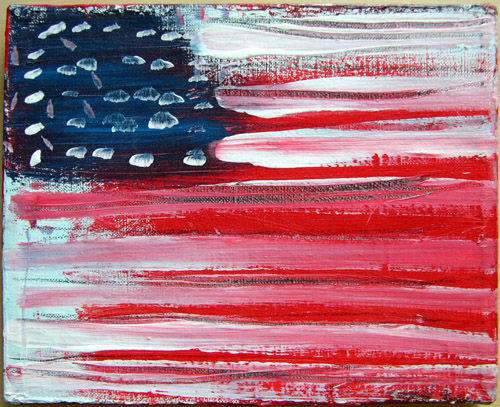


“WE ARE YOU,” US Latinization's Next Wave:
ESTABLISHING A “NEW” DIRECTION FOR 21st CENTURY LATINO ART IN THE USA: The Ground-breaking Emergence of the We Are You Project’s WAY IT’S Art Exhibition
by Dr. José Manuel Rodeiro, MFA, Ph.D. (Visual Artist Fellow of The National Endowment for the Arts; Fulbright Scholar, and Cintas Fellow).
“Freedom has many difficulties and democracy is not perfect. But we have never had to put a wall up . . . .”
------------------- President John F. Kennedy's Berlin Wall Speech, 1963.
“Finish the border fence now.” ------------------- US Senator Jim DeMint of South Carolina, 2010

Frédéric Bartholdi‟s “Statue of Liberty”
From its inception in 2005, New York City's We Are You Project (WAY) has been a revolutionary Latino socio-artistic phenomenon ripe with both national and global implications, using art to shed light on five pertinent 21st Century Latino themes: 1). Latino immigration, 2). Latinization, 3). the current Anti-Latino backlash, 4). The rise of Pan-Latino transculturalism, as well as examining 5). Latino identity in the 21st Century. Also, motivating the We Are You Project are recent US Census figures, which indicate that after 2060 CE, the US-Latino population will represent 51% of the total US-population. Wisely, WAY apprehends the inevitability of Latino population growth, realizing that it will occur despite the height-and-length of ridiculous billion-dollar barbed-wire topped fences and walls along the Rio Grande and the Sonoran Desert. The reaching of a 51% majority status after 2060 CE will redefine or reclassify Latino culture and Latino art as America's dominant “mainstream culture and art.” This glaring US socio-cultural inevitability is known as Latinization, whose greatest manifestation will be felt economically, in terms of Latino buying power; as well as politically, as Latinos assume greater political-awareness and activism.
Already, Latinization is apparent in the arts (i.e., movies, music, dance, visual art, and other art-forms), fulfilling the enlightened prophecy made in 1987 by art-critic Barbara Rose in New Criterion magazine, where she claimed that Latino Art is, “Among the best art being done in America.” Today, as manifested by the We Are You Project's daring artistic initiatives, Rose's assertion remains a farsighted and accurate observation. Yet, as a “way” (by means of art, culture, and creativity) for Latinos to address immigration, Latinization, Anti-Latino ethno-racism, pan-Latin transculturalism and Latino identity, the We Are You Project did not arise over-night from thin-air, rather WAY’s post-2005 legacy can be traced to America's socio-political struggles for civil rights, tolerance, and freedom spanning from the late-18th Century until now.
As a “way” to spotlight the contributions of US-Latinos within America's (1776 until now) history of socio-political struggle for civil rights, tolerance, and freedom, the We Are You Project has initiated a landmark artistic initiative; selecting and presenting key Latino artists and art-works for a global-venture known as the We Are You International Traveling Show (WAY IT’S), which has garnered a comprehensive array of art-works done by major contemporary Latino artists, reflecting ancestral heritages from over a dozen Latin American nations. Most importantly, these selected artists examine or exemplify difficult 21st Century Latino concerns, i.e., immigration, Latinization, discrimination, pan-Latin transculturalism, cultural identity as well as recent examples of growing US ethno-racism. Behind these problematic Latino concerns, their contextual impetus ensues from eight (8) key Latino socio-political and art historical events, affecting every Latina/o living in the USA. The primary sources of WAY IT’S subject matter and iconology are these eight decisive “US-related” socio-political and art historical events, which include: 1). The fact that Frédéric Bartholdi's “Statue of Liberty” was influenced by Edouard de Laboulaye's symbolic interpretation (or analysis) of the US The Bill of Rights. 2). The recent bevy of unconstitutional Latino immigration laws (e.g., Arizona, Alabama, Georgia, South Carolina, and other states) that have unjustly targeted Hispanics. 3). The 14th Amendment’s “untapped” inherent potential to provide civil-rights protection to Latinos, as well as basing current Hispanic needs for civil rights upon the sterling example of Dr. Martin Luther King and the Southern Christian Leadership Conference's (SCLC's ) struggles for African-American civil rights in the late-1950s and throughout the 1960s. 4). The Pro-Latino implications of the 1954 Supreme Court ruling known as Pedro Hernandez v. The State of Texas. 5). since 1992, the rise of “Latinization.” 6). The official 1992 national US celebration of 1492's Quincentenary. 7). The 1977 rise of Latino Postmodernism and 8). current 21st Century pan-Latino transculturalism. These eight socio-political and artistic “ideas”/”events” comprise the We Are You International Traveling Show’s prime motivations.
The Impact of Edouard de Laboulaye's Ideas on Bartholdi's “Statue of Liberty:"
Paradoxically one of the prime influences motivating 21st Century WAY IT’S art is Frédéric Bartholdi's “Statue of Liberty;” a 19th Century work of art, which “currently” terrifies hardnosed US rightwing extremists, because that magnum opus symbolizes an open-door policy toward immigration, “welcoming” what right wingers deem to be highly undesirable: a glut of Latino immigrants and refugees. Sadly, the US political right cannot fathom or comprehend the value of additional Latino immigrants, or worse, they hate the colossal bronze statue because they astutely interpret Lady Liberty's hidden iconology, correctly --- as it was originally described and intended by 19th Century French historian Edouard de Laboulaye.
In 1865, during a party near Versailles at the home of Edouard de Laboulaye, the conversation turned
to Abraham Lincoln's assassination, prompting the host to assert that the USA's victory in the Civil War
and Lincoln's martyrdom signified America's striving to achieve the ideals celebrated within three of its
founding-documents: Declaration of Independence (1776), the US Constitution (1788), and The Bill of
Rights (1791). De Laboulaye insisted that the The Bill of Rights was the most inspiring. Among the
guests was Frédéric Bartholdi, a young Alsatian Beaux-Arts neo-classical sculptor. De Laboulaye sug-
gested to Bartholdi that a sculptural-tribute ought to be erected, honoring the ideal of universal human
“Freedom” for which Lincoln died, as well as the 625,000 US Civil War combatants. De Laboulaye in-
sisted that it should be a monument about all humanity's (as well as the USA's) eternal aspiration to at-
tain the ideals engraved in The Bill of Rights. Furthermore, he suggested that preferably France should
create and provide such an impressive gift for the 1876 centennial celebration commemorating the 1776 American Revolution, ---- to which, Bartholdi proclaimed, “I will do it!”

Frédéric Bartholdi‟s “Statue of Liberty”
Curiously, during de Laboulaye's party, the discussion had been about the US Civil War (1861-1865); nevertheless, as the last guests departed, it was clear that this friendly get-together had germinated a trans-Atlantic plan for a colossal French sculpture entitled, La Liberté éclairant le monde (Liberty Enlightening the World), which would continually celebrate and reaffirm the virtues of America's Revolution (1776- 1783). Even today, this gigantic and thought-provoking memorial continues to rouse great hope among all freedom-loving and just people, who see Lady Liberty standing defiantly in New York's harbor. Stealthily, the Statue of Liberty's capacity to inspire hope results from its inherent “Laboulayean” iconology, which ingeniously implies that the USA's 19th Century Civil War was merely an extension of America's 18th Century Revolution. Evidence of this is apparent in the broken chains at the feet of the statue, which symbolically references Lincoln's 1863 emancipation of the slaves.
The first artist to fully comprehend these innate “Laboulayean” motifs that cloak Bartholdi's The Statue of Liberty was the Brazilian Postmodernist Duda Penteado in his Neo-Neoexpressionist piece entitled We Are You (2005), which presents a colorful hyper-emotive image of a Latina mother protecting her infant child, symbolizing America's emergent 21st Century Latino population. Throughout his We Are You piece, Penteado ingeniously alludes to Bartholdi's Liberty, as well as de Laboulaye's insistence that America must continue to cultivate The Bill of Rights (with its ideals of fairness and due process) hopefully praying that in the 21st Century, these Rights will protect Latinos from the throng of 21st Century unconstitutional and anti American laws recently passed in Arizona, Alabama, Georgia, South Carolina, and other states, which unfairly target Hispanics.


Similar to Penteado's fascination with Lady Liberty, the grand master of Latino contemporary art, Raphael Montañez Ortiz, the Founder in 1969 of El Museo del Barrio (East Harlem, NYC) created a large (5' x 9') digital collage masterpiece entitled Liberty in a Tempest Teapot (2011), utilizing Batholdi's Statue of Liberty as an allegorical metaphor. Additionally, Ortiz's daring image provides a thought-provoking satirical rewriting of Emma Lazarus's New Colossus poem (1883), which he ironically alters to describe the current heartbreaking betrayal of the US Bill of Rights by blustering far-right extremists within the new-fangled Tea Party, who avidly advocate repressive discrimination against Latinos. Ortiz's dramatic image bravely solicits, “Who or what will save America from this rising 21st Century anti-Latino neo-fascist storm?”
Raphael MontañezOrtiz “Liberty in a Tempest Teapot” 2011, Digital Collage Painting, 5‟ x 9‟ (Collection of the Artist).
Duda Penteado “We Are You” 2005, Acrylic on canvas, 48” x 24” (Collection of the artist).
The Inherent Potential of the 14th Amendment’s to Protect the Civil Rights of Latinos [(Today, another Hernandez v Texas (1954) is urgently needed to reinforce the 14th Amendment's “birth-clause” as an unambiguous and clear indication of US citizenship)]:

The next momentous event affecting the We Are You Project’s ascertainable history occurred three years after the end of the Civil War in 1868, when the 14th Amendment to the US Constitution was ratified, guaranteeing citizenship to "all persons born in the United States.” Yet, in 2011, the State of Alabama (and likewise earlier Arizona and other states, which have generated similar laws) passed H.B. 56, an ethno-racist law abridging the "privileges and immunities" of Latino citizens, thereby, denying Hispanics fair and equal legal protection(s) and benefits. Alabama's 2011 unconstitutional law H.B. 56 went so far in its anti-Latino calumny as to deny citizenship to natural born US-citizens.
Forlornly, due to the 21st Century's rising tide of intolerance, discrimination, unconstitutional laws and pure anti-Americanism; sadly, the broad protective-power of the 14th Amendment has been unable to fully safeguard US Latinos from the rampant bigotry evident in several states' anti-Latino legislative-agendas. At this time, Latinos desperately need another ground-breaking Pro-Latino Supreme Court ruling; such as the 1954 case known as Pedro Hernandez v. The State of Texas. This case was successfully argued, (by two valiant Tejano Lawyers, Gus Garcia and Carlos Cadena), heroically deliberating before the US Supreme Court of Chief Justice Earl Warren in 1954. Thankfully, the high court's ruled in support of Hernandez, which granted Latinos for the first time in US history appropriate due process under law, extending to Latinos the full power of the US Bill of Rights; as well as designating Latinos as being (ethnically and racially), a “Class Apart.”
Gus Garcia, heroically deliberating before the US Supreme Court of Justice Earl Warren in 1954.
Today, Latinos need another case like Hernandez v Texas to reinforce the 14th Admendment's “birth-clause” as a valid indication of US citizenship. Alabama's new law H.B. 56 unjustly questions Latino children's US-birth right, depending on whether one or both parents are illegal aliens; such legislation relates directly to the issue of Latino identify; a pivotal concern within WAY IT'S's aesthetic parameters.


Among the WAY IT‟S artists grappling with contemporary Latino identity is Colombian-American artist Sergio Villamizar, who juxtaposes double frontal self-portrait mug-shots (or passport-photos), wherein he uncompromisingly confronts himself (his actual facial features), his “being,” depicting one self-portrait with swarthy complexion and a moustache, the other with bleached skin and no moustache. Since so much, of what negatively confronts Latinos, pertains to immigration policies, the ambivalent and humorous irony in Villamizar's photographic self-portraits affords little distinction between these photos possible function as being paradoxically perhaps “portraits,” “mug-shots,” or “passport-photos.”
The use of identity as a fulcrum for figurative imagery is evident in the work of Cuban painter, Raul Villarreal, whose ancestral lineage includes heredity from Taino-Culture, Africa, and Spain. As a result, in his image entitled No Longer (IN)Visible (acrylic & oil on canvas, 48” x 36,” 2004) explores Latino identity. Additionally, this duende-filled self portrait alludes to Afro-Caribbean religious motifs, particularly those associated with Palo Monte (Palo Mayombe Religion), as well as referencing Ralph Ellison's Invisible Man (published in 1952). Villarreal's art reflects Ellison's inner (immanent) psychological awareness; whereby, in order to hide; often people dissemble their identity, placing too much emphasis on what is seen and not enough on what is felt, or just under the surface. For this reason, Villarreal's self-image is transparent, revealing at its core-essence: a vital throbbing heart. In these raw heartfelt concerns, Latinos are precisely what Earl Warren described, “A class apart!”
Sergio Villamizar “Before and Happily Ever After” 2006, Digital Print , 24” x 32” (Collection of the artist).
Raul Villarreal “No Longer (IN)Visible” 2004, Acrylic and oil on canvas, 48” x 36” (Collection of the artist).
The Groundbreaking Significance of the 1992 Quincentenary and the Dawn of Latinization:
In terms of art and culture, the We Are You Project’s 21st Century agenda has its art historical roots in three earlier 20th Century and 21st Century Hispanic events, enterprises, and endeavors: 1). The 1992 Quincentenary awakening (or first simultaneous “coast-to-coast” national emergence) of US Latino art and culture, including the genesis of the term “Latinization;” 2). The unexpected advent of Latino Postmodernism in Cuba in 1977 and its arrival in Miami and New York in the 1980s, and 3). The first at-tempts at Pan-Latino Transculturalism (including the first transcultural Latino art movement of the 21st Century: “Neo-Latinoism”).
For anyone studying the evolution of Latino Culture, nothing is as “eye-opening” about Latino history as the 1892 400th anniversary of Columbus's arrival in the New World, which remarkably did not focus attention on US-Latinos; instead the emphasis was placed on Italian-Americans and on other non-Spanish speaking European nations, as well as marginally including such ethnic curiosities as subjugated US Amerindian tribes living “peacefully” on reservations. The nation-wide neglect of Latinos during the USA's October 1892 400th-year celebration of the 1492 “Discovery of America by Columbus” exposes both the utter political and economic powerlessness of US Latinos in the late-19th Century, and the growing US anti-Latin mood attributable to the pending imminent war with Spain (1898), wherein American soldiers fought and died in Puerto Rico, Cuba, and the Philippines, etc. Or, the USA's 1892 awareness of an inevitable confrontation with Colombia in order to secure the Panama Canal (1903), as well as other Caribbean and Central American US Marine peacekeeping incursions, throughout the 19th Century fin de siècle. Thus, the focus of the 1892 Commemoration of Columbus's arrival generally spotlighted and honored Italy as Columbus's alleged birthplace, as well as the birthplace of thousands of arriving (via Ellis Island) Italian-American immigrants.
Conversely, one hundred years later during the United States of America's 1992 Quincentenary Celebration, for the first time (if only for one year (1992)), Latinos were properly highlighted, studied, and noticed, rightly attaining the full focus of the USA's celebration, marking the 500-year observance of Christopher Columbus's 1492 encounter with indigenous Americans, which then sparked from the 16th Century onward “New World” and “Old World” contact(s), interactions, conflicts as well as intercourse (sexual-coupling), igniting the initial growth of North American Latino culture as well as Latin-American “Latin” culture.
The 1992 Columbus Quincentenary afforded US Latinos moments of self-realization and self-awakening, seeing (for the first time) glimpses of their bright future as US citizens. Nevertheless, the 1992 Quincentenary did provide Latinos with the first ray-of-hope that their lives in the USA might improve. For example, in this optimistic light, on Monday, October 12, 1992, at Goucher College, (Baltimore, Maryland) during an art historical lecture by the author of this essay (Dr. José Rodeiro), he used for the first time, the term “Latinization” to characterize the objectives of a Quincentenary Latino art show organized by Helen Glazer (the Director of Goucher College's Rosenberg Gallery), which she titled "Approaching the Quincentenary: Latino Art 1982-1992." The term Latinization was invented by Rodeiro to denote the inescapable growth and spread of Latino culture throughout the USA, including the inevitable 21st Century absorption of Latino culture by the US-mainstream (which shortly after 2060 CE will manifest and mark an unavoidable cultural shift) establishing the predominance in the USA of Latino values, art, music (dance), food and lifestyle.

The most prestigious and ambitious show, which occurred on the eve of the Quincentenary (1987) was "Hispanic Art in the United States: Thirty Contemporary Painters and Sculptors," which featured 180 Latino works-of-art carefully curated by Jane Livingston and John Beardsley, including works by Chicano artists like Carlos Almaraz, Gilbert Lujan, Frank Romero, and Gronk. Importantly, Livingston and Beardsley established the Los Angelino catatonic-schizophrenic, Martin Ramirez (1885-1960) as a Latino art trailblazer. Art histori-cally, Livingston and Beardsley wisely placed three well-known sculptors Luis Jiminéz, Robert Graham, and Manuel Neri appropriately as significant Latino art pioneers.
For this reason, thanks to the Quincentenary, in-and-around the year 1992, the USA's mainstream “art world” was overtaken by the need to finally and seriously focus on Latino art and culture “for an entire year.” In 1992, to mark the occasion, Spain proudly sent replicas of Columbus's three tiny ships to New York City. Suddenly, all the top Latino artists were in demand for a series of groundbreaking Quincentenary Latino art exhibitions that would define the “general” nature of Latin Art to “the present.”

Frank Romero “The Arrest of the Paleteros” 1996, Oil on canvas, 8‟ x 12‟

Carlos Alfonzo “Where Tears Can‟t Stop” 1986,
Acrylic on canvas, 8‟ x 10‟
Of all the groundbreaking Quincentenary shows that occurred in 1992, the best was "Approaching the Quincentenary: Latino Art 1982-1992," organized by Helen Glazer, the Director of the Rosenberg Gallery, Goucher College, Baltimore, Maryland, featuring major postmodern Latino artists, including: Cuban American artists: Arturo Bassols, Maria Castigliola, J. Tomas Lopez, Tomas Marais, José Marin, Maria Sonia Martín, José Rodeiro; and the Puerto Rican-American artists:
Maritza Davila, Peter Gaztambide, Carlos Suenos, and Chicano artist Luis Jimenez. Another major Quincentenary show occurred at the Smithsonian's Hirshhorn Museum, entitled "Crosscurrents of Modernism: Four Latin American Pioneers" emphasizing the top four Latin American 20th Century masters, who had, according to the Smithsonian, dominated 20th Century art: Diego Rivera (Mexico), Joaquin Torres-Garcia (Uruguay), Wilfredo Lam (Cuba) and Roberto Matta Echuarren (Chile). This show provoked heated controversy due to the exclusion of Frida Kahlo.

Learning from such appalling acts of gender-bias and chauvinism, as the exclusion of Frida Kahlo from the Hirshhorn's "Crosscurrents” Quincentenary exhibition, today, the We Are You Project WAY IT’S exhibit has attracted a strong coterie of eminent feminist Latina artists, i.e., Marta Sanchez, Rosario D' Rivera, Josephine Barreiro, Jacqui Casale, Maritza Davila, Lisette Morel, as well as others.
Luis Jimenez “Vaquero” 1987, Polychrome Fiberglass, 16‟ x 9‟ x 5‟ (Smithsonian Collection: National Museum of American Art).


Josephine Barreiro “Divided We Stand” 2011, Acrylic and paper on plywood panel, 30” x 40” (Collection of the art- ist).
Rosario D‟Rivera “Mujeres Unidas En Libertad” 2011, Mixed media 22” x 28” (Collection of the artist).
Marta Sanchez “Retablo for Women of Juarez” 2011, Oil and enamel on metal, 36” x 24”
In their images, Sanchez and Barreiro explore different aspects of Neo-Neoexpressionism from the gritty hyper-emotive art of Barreiro to the inspired fanciful images of Sanchez; while the paintings of D'Rivera, Casale, Morel, and Davila create vivacious monumental lyrical abstractions that are paradoxically, at the same time, both formal and whimsical.
Jacqui Casale “And the Walls Come Tumbling Down” 2011, Mixed Media, 20” x 24” (Collection of the artist).


Lisette Morel "Mapping Series: Red White and Blue, Does it change the work, if I am Dominican?" Acrylic on New York City subway map, 33" x 25", 2011
Dávila Maritza "Manos en busqueda de un idioma/Hands in search of a language", 2011
Screen printed artist book
15.25" x 5" x 14", (Collection of the artist).

José Bedia "Untrappable" 1998
As more refugee artists arrived in Florida, a vibrant gallery-scene emerged in Miami. In 1983, the surge of Miami-Cuban art was the focus of the “Miami Generation” show, inaugurating the Cuban Museum of Art and Culture, Miami. Other significant Cuban-American exhibitions followed, including “Outside Cuba,” 1987, “Cuba-USA,” 1991, curated by Giulio Blanc, or the 'Breaking Barriers' Show, 1997, curated by Jorge Santis. Also, significant (since first attempted by Wifredo Lam in the 1940s) is the predominance in visual art of spiritual motifs relating to Santeria as well as other Afro-Caribbean religions, especially among Cuban Neo-Expressionism e.g. Luis Cruz Azaceta, José Bedia, Paul Sierra, Pedro Pérez, Tomas Esson, and Carlos Alfonso (1950-1991). Since 1990, Cuban-American radical Postmodernism has merged with Neo-Surrealism and Hyperrealism; this is evident in the masterful art of Tomás Sánchez, Jesus Rivera, as well as Raul Villarreal. Villarreal‟s paintings of isolated stately Royal Palm-trees that stand erect against bright blue skies or dramatic sunsets with occasional symbol-laden clouds (connoting maps of Cuba), such images express a heartbreaking nostalgia for Cuba, e.g., With(IN) Skies, (acrylic & oil on canvas, 30 x 60, 2005).

Raul Villarreal “With(IN) Skies” 2005, Acrylic on canvas, 30” x 60” (Collection of the artist).
Pan-Latino Transculturalism:
By 2001, the brilliant Puerto-Rican American curator Dr. Isabel Nazario (at that time, director of the Rutgers University's Center for Latino Art & Culture) began organizing a series of major comprehensive Latino exhibitions, which would evolve into the acclaimed innovative endeavor known as The Transcultural Art Initiative in New Jersey and New York. By thoroughly researching the top Latino artists in the New York/New Jersey region, Nazario carefully planned a series of edifying landmark Latino exhibitions, featuring (to name a few of the artists) Carolina Alvarado-Narvarette, Michele Araujo, Yolanda Avila, Hugo Bastidas, Olga Bautista, Antonio Carreño, Alphonso Corpus, Jo-Anne Echevarria-Myers, Eugenio-Espinoso, Benedict J. Fernandez, Diana Gonzalez Gandolfi, Diosmel González, Noe Hernandez, Maria Lau, Mariana Maldonado, Claudio Mir, Alexandra Morel, Raphael M. Ortiz, José Rodeiro, Fausto Sevilla, Tony Velez, Raul Villarreal and others.

Dr. Nicomedes Suárez-Araúz
During the end of the 20th Century and the start of the 21st Century, a group of creditable Latino art critics, curators, and theorists manifested, including foremost Luis Camnitzer, Conceptualism in Latin American Art (Austin: University of Texas Press, 2007); Mari Carmen Ramírez, “Tactics for Thriving on Adversity: Conceptualism in Latin America, 1960-1980,” in Global Conceptualism: Points of Origin, 1950s-1980s. Also, contributing to the growing realm of Latino contemporary “art-ideas” were Nicomedes Suárez-Araúz, Shifra Goldman, Alejandro Anreus, Tomas Ybarra-Frausto, Isabel Nazario, Rocío Aranda Alvarado, Denise Carvalho and José Rodeiro.
Isabel Nazario's The Transcultural Art Initiative (2001-2005) encouraged a phenomenon known as the “Neo-Latino Art Movement.” In 2003, the name for this phenomenon (“Neo-Latino”) was invented by Cuban artist Raul Villarreal to describe a cluster of New York City Metropolitan-area artists, who advocated nascent rudimentary-forms of Pan-Latino transculturalism. From 2003 until 2006, this group dominated New York/New Jersey's Latino Art scene, participating in scores of major regional exhibitions. The core group included Olga Cruz (the leader), Josephine Barreiro, Hugo X. Bastidas, Olga Mercedes Bautista, Gerardo Castro, Leandro Flaherty, Raniel Guzman, Hugo W. Morales, Jason Rivera, José Rodeiro, Raúl Villarreal, Sergio Villamizar, and William Coronado, as well as others.


Neo-Latino exhibition at the Harold B. Lemmerman Gallery (NJCU), artists Hugo Morales, Raniel Guzman, Gallery Director Midori Yoshimoto, NJCU President Carlos Hernandez, artist Gerardo Castro, and artist, art historian , and coordinator of Art History at NJCU Dr. José Rodeiro.
Hugo Xavier Bastidas “Bearing Gifts” 2009, Oil on canvas, 24” x 36” (Via The Nohra Haime Gallery).
A growing awareness of Latino transculturalism permeated early-21st Century Hispanic art and culture. For example, along with Mexican master Roberto Márquez, Ecuadorian American artist, Hugo Xavier Bastidas is considered one of the top Latino artists working in the United States. In the early 21st Century, Bastidas was one of the founding Neo-Latino artists, who in 2009 along with Josephine Barreiro, Gerardo Castro, Hugo W. Morales, Sergio Villamizar, Williams Coronado, José Rodeiro and Raul Villarreal joined the We Are You Project's WAY IT’S initiative; for which he generated an extraordinary oil painting entitled Bearing Gifts, analyzing the human cost of crossing the Rio Grande into “El Norte.” Bastidas's painting provides an ironic insight into the tragic nature of illicit border-crossings. First, the title contains the word "Bearing," which relates to an image (in the center of the composition) of a discarded toy bear accidentally dropped on a patch of cacti by a child during a traumatic run across the Rio Grande. The word "Bearing" also connotes "conveyance," since undocumented-aliens frequently carry all their prized-belongings on their journey. Lastly, the word is a pun on the name of Vitus Bering, the Danish sea-captain employed by the Russian Navy of Czar Peter the Great. Captain Bering
was ordered to find a Pacific Ocean route from Russia to Mexico. In 1725, he accidentally discovered the Bering Straits, the prehistoric passageway by which the ancient Amerindians presumably arrived in all the Americas. Via his brown-sepia image of a lost toy bear, Bastidas brilliantly reverses the concept of courageous journeying, discovery, and exploration, by conceding these heroic qualities to illegal immigrants and their daring attempts to enter the US illicitly. Also, significant to Bastidas's image are Amnesis aesthetic ideas inherent in Bolivian poet Nicomedes Suárez-Araúz's Theory of the Lost Object.
A 21st Century Longing for a Latino Renaissance:
As the 21st Century emerged, Hispanics from the Pacific Coast to the Atlantic Coast hungered for a 21st Century US-Latino Renaissance, realizing that such a cultural renewal would in all likelihood invigorate the whole US-art scene. By 2010, the longing for a Renaissance increased; especially, after the Islamo-fascist attacks of 9/11/2001, and the resulting excruciating and interminable US-led “War on Terror” that indirectly effected the US-economic collapse of 2007- 2008. During this dark time, much of mainstream US visual art generally favored various postformal and a-formal approaches to art-making. These were mostly anti-creative methodologies that were mostly “un-visual,” and by-and-large hyperconceptual, mechanical, inhuman, ersatz, sheer technology, text-based, inauthentic, anti-art (Neo-Dada/Neo-Fluxus), invisible and un-emotive. These early-21st Century hyper-conceptual methods espoused the current Western academic “anti-art” dogma. Yet, during this sad period in the history of art (which is
best exemplified by the last two Whitney Biennials); Latino art courageously bucked all effortless anti-art trends, and continued to bravely emphasize the visual-nature of visual art; perhaps resulting as Gertrude Stein argued in Everybody’s Autobiography (1937) from an “innate” Iberian awareness of their unique intensely ocular Hispano-art history, which persistently and historically insists that visual art must be first and foremost VISUAL! For this reason, certainly any feasible and viable 21st Century US-Latino Renaissance would require firm art historical grounding, necessitating a sweeping and expansive cosmic historical overview of US Latino culture and art from 1492 until today. Notably, the We Are You Project is currently undertaking such a valorous, bold, sweeping and expansive art historical overview of Latino art from the early-16th Century onward.
Among aestheticians anticipating a 21st Century Latino reinvigoration of all the arts was the Bolivian-born poet and theorist Nicomedes Suárez-Araúz, whose book Amnesis: The Art of the Lost Object (1988) propounded a new and influential concept, based on amnesia as a structural metaphor for creativity, viewing the realm of the forgotten as both the essential source and the elemental form of all artistic creativity and fabulation. In the 21st Century, according to critic Sunka Simon, Amnesis remains a growing aesthetic concern. Also, significant to this highly desired emergence of a Latino Renaissance was the surfacing in 2010 of the We Are You Project's WE ARE YOU INTERNATIONAL TRAVELING SHOW (WAY IT’S), which was initiated by Dr. Carlos Hernandez (President, New Jersey City University (NJCU)); Mr. Mario Tapia (President and CEO, Latino Center on Aging (LCA)), and Duda Penteado, (a Brazilian contemporary artist living in the New York's metropolitan-area).
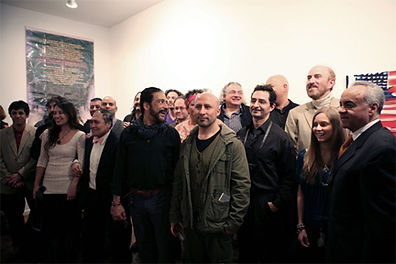

Dr. Carlos Hernandez (President, New Jersey City University (NJCU)); Mr. Mario Tapia (President and CEO, Latino Center on Aging (LCA))
WE ARE YOU INTERNATIONAL TRAVELING SHOW artists at the inaugural exhibit in the Wilmer Jennings Gallery, NYC.
THE WE ARE YOU INTERNATIONAL TRAVELING SHOW (“WAY IT’S”):
Starting in the late-1990s, Duda Penteado, (who, along with Vik Muniz, Priscila De Carvalho, and Romero Britto, is one of the most celebrated Brazilian artists working in the USA), slowly began to envision a unique Latino global visual-art initiative, reflecting a revolutionary concept that would transform and facilitate new activism, and socio-political renewal, and unification among all Latinos: “Pan-Latino Transculturalism.” The heroic first steps in this venture began in 1997, when Penteado met Dr. Carlos Hernandez, a prominent New Jersey Latino university president with almost 40 years of service in American higher education. Then, in 2000, Penteado met Mr. Mario Tapia (President and CEO, Latino Center on Aging (LCA)), who joined this key initial group of Latino “cultural-visionaries.” Tapia had devoted over thirty years of his life to helping Latinos throughout the New York metropolitan-area, as well as nationally and internationally. Both of these men had a profound impact upon Penteado's rising concern for the complex milieu surrounding the lives of most US-Latinos, affecting a growing notion (within him) that the USA was in dire need of radical cultural and artistic reforms.


Duda Penteado, Brazilian artist
Dr. Carlos Hernandez, NJCU President
Thus, at the dawn of the 21st Century, Hernández, Tapia, and Penteado saw a clear and pressing opportunity for a thorough overhaul of American culture in order to properly accommodate the USA's growing Latino populace. They saw the possibility of a volcanic paradigm-shift that would reinvigorate all of America's art, education, political-activism, health-care, immigration policy and encourage a “new” comprehensive and “hands-on” or “ground-level” social-work system that would properly meet community-needs in a straightforward manner, as well as the thorough review of US and global socioeconomic structures and other vital issues, which they (Hernández and Tapia) deemed necessary for the improvement and transformation of 21st Century and 22nd Century American culture and life.

By 2001, Hernández and Tapia pointed out to Penteado that US-Latino culture in the urban environment was undergoing dramatic renovation(s) that permitted greater transcultural Latino unity (e.g., Pan-Hispano transculturalism and Latinization, as well as the prospect a broad socio-economic transformation, including introducing within the US a completely “New Latino” identity or persona capable of greater access into the American Dream, mainstream US-culture, and socio-economic success, which was (at that time and even now) to some extent only available generally to “well-educated” Latinos. Most importantly, they believed that the arts were central component or a crucial ingredient of such a Renaissance.
As the “War on Terror” ensued after the attacks of 9/11/2001, many Latinos became the front-line military cohort fighting the Mid-Eastern conflict. Due to the 9/11 attacks, the US began to tighten its border-security, which affected primarily Latinos. Consequently, this post-9/11 US paranoia (with its unexpected targeting of Latin immigrants) fostered a new Hispanics civil-rights awareness. And, by means of emergent transculturalism, Latinos of different ethnicities and national-origins were finding common ground, and greater Pan-Latino unity.
Mr. Mario Tapia (President and CEO, Latino Center on Aging LCA).
As a result, Tapia, Hernández, and Penteado began to notice that “Latinization” was gaining momentum, attaining greater prominence (in US popular-culture), as well as making strong headway within various US financial arenas, while advancing Latin art and culture deeper-&-deeper into the American mainstream, fermenting new and daring Pan-Hispano ideas (i.e., Neo-Latinoism, transculturalism, cultural-hybridization and other concepts associated with the prevalent 21st Century “Latino Condition”), evolving and manifesting as a growing transcultural phenomenon throughout all American society, effecting every aspects of US culture. This mounting surge of “Latinization” crystallized in 2005, when Penteado was selected to design the official poster for the 2nd National Conference on Latino Aging, for which he boldly created an expressionistic symbol (or an emblem) capable of embodying the spirit of America's new-Latino identity. In June 2005, the poster was first unveiled, during LCA‟s 13th Golden Age Awards banquet in New York City, during the dedication, Tapia delineated that Latinos were attaining a new status in the 21st Century; which led him to pronounce, “We Are the USA.” An idea that Penteado immediately took to heart and brilliantly refashioned into the concept known as: “We Are You,” which became the title of Penteado's art work.

People protest in front of the U.S. Supreme Court as the court hears oral arguments on Arizona immigration law. Photo: Mark Wilson/Getty Images
Soon the We Are You Project’s 2012-2018 global initiative known as the “We Are You International Traveling Show” (“WAY IT’S”) appeared as a reality. Art historically, the WAY IT’S arose from the tragic confluence of several epic-events and the “ongoing” dilemma precipitated by those sad events (described below). From 2005 onward, as more-and-more Latinos exerted themselves and flourished in the USA and in the world, attaining recognition and wealth. However, unexpectedly, an anti-Latino backlash arose, which was sparked by growing ethno-racism energized by “fear-fueled” apprehension, mistrust, envy and paranoia (trepidation), deriving from and concerning the 2007-2008 collapse of the United States‟ economy, which unleashed a torrent of anti-Latino bias and intolerance, reaching its apogee in Arizona in 2009, followed by a series of Anti-Latino laws that were enacted in four states (mostly in Arizona, as well as Oklahoma, Missouri, and Alabama), with the most draconian occurring in Alabama in 2011. The worst provisions of these new laws blatantly violate the US-Constitution, e.g., the revoking of any US-born Latino citizen‟s “citizenship,” if either both or any one parent is proven to be undocumented. Sadly, additional anti-Hispanic laws are under consideration in other states (i.e., Georgia, South Carolina, Virginia, Pennsylvania, etc.). From 2009 onward, Latinos more-and-more were being designated personas non grata in the USA; or identified as scapegoats for all that ailed America.
The fact that Latinos were suddenly being noticed led to the awareness of the growing importance of US Hispanics. This growing realization sparked a large-scale Latino Conference in April, 2010 at NJCU that would examine every aspect of Latino culture and life. As part of this Latino Conference, a panel was composed on the topic of contemporary art moderated by Dr. Carlos Hernández entitled Art as a Catalyst for Social Change: “WE ARE YOU.” Participating, in the event, along with Duda Penteado, was Dr. José Rodeiro [(Coordinator of Art History at NJCU, and an acclaimed artist and scholar)], and other speakers were involved in the panel, including art historian Dr. Sara Gil Ramos (Adjunct-Professor at NJCU) and curator and scholar Fausto Quintanilla, Gallery Director, Queensborough Community College Art Gallery, NYC, NY). As part of the aftermath of this conference, Penteado asked Rodeiro, as well as Robert Rosado (the Union City (NJ) Puerto Rican impresario), and Raul Villarreal (the prominent metropolitan-area Cuban artist) to form a subcommittee to explore avenues by which topnotch Latino artists might join the We Are You Project.
Soon an array of thirty prominent Latino artists from the full-breadth ((coast to coast)) of the USA, as well as Latin America manifested, answering the “CALL,” which was promulgated online (and is currently visible on the We Are You Project Website). The thirty that answered the call were endowed with hereditary national ancestries or heritage from Mexico, Puerto Rico, Cuba, The Dominican Republic, Colombia, Ecuador, Peru, Uruguay, Brazil, and Spain, etc. Thus, the exhibiting artists of the We Are You International Traveling Show (WAY IT’S) materialized throughout 2010 and 2011. The artists that joined WAY IT’S were involved in the following innovative and “cutting-edge” current Latino styles: “Neo-neoexpressionism,” “Metaphorical Realism,” “MysticLyricism” (“Eye-opener Art”), “Neo-Metaphysical/Urban Assemblage Art,” “Neo-Ultraism” (“Infra-realism”), and “Neo-Pop." For example, among the WAY IT’S cohort is a dazzling coterie of artists pursuing 21st Century Neo-neoexpressionism; this group includes: José Acosta, Josephine Barreiro, Duda Penteado, Marta Sanchez; plus, occasionally Hugo Morales (whenever he is creating additional expressionistic works for his ongoing hyper-emotive Silent Scream Series); in addition, within this stylistic-category is the urban industrial landscape Cuban artist, Nelson Alvarez. However, art historically, Alvarez's WAY IT’S submission for the exhibition, (a floor-piece entitled Imaginary Border (diptych)), has a certain “Neo-HairyWho” aspects, as well as functioning within the context of Neo-Metaphysical “Urban-Assemblage Art.”

Jose Acosta “Hispanic Pride” 2011, Acrylic on can- vas, 24” x 32” (Collection of the artist).

Hugo Morales “Untitled-Silent Scream Series” 2004, Acrylic on canvas.
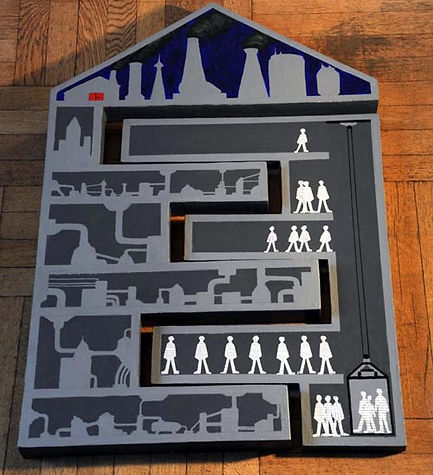
Nelson Alvarez Imaginary Border (diptych), 2011, Acrylic on wood and collage 36" x 24" (Collection of the artist).
Another stylistic-method perceptible in the WAY IT’S exhibition is “Metaphorical Realism.” Mimetically and poetically, this particular “visual-narrative” mode connects symbolic representational imagery (mimesis) to “visualization” or story-telling: fabulation. There are a dozen WAY IT’S artists that create unique iconological narratives, whose style is “generally” identified with a radical postmodern style known as “Metaphorical Realism,” e.g., Willie Báez, Hugo Bastidas, Gerardo Castro, William Coronado, Roberto Marquez, Raphael Montañez Ortíz, Joe Pena, Jimmy Pena, Jesus Rivera, José Rodeiro, and Raúl Villarreal.


Willie Báez “Post No Bills in Spanish” 2011, Acrylic on paper Collage, 24” x 18” (Collection of the artist).
Roberto Márquez “Map of Mexico” 2011, Oil on canvas, 34”x 24” (Collection of the artist).
Joe Pena “Elisa, M.N.” 2011, Oil on canvas, 10” x 10” (Collection of the artist).

Jimmy Pena “Esfuerzo” 2004, Print, 24” x 55” (Collection of the artist)
On the other hand, a bevy of WAY IT’S artists are experimenting with Mystic-Lyricism (or “Eye-opener Art”); these are Fernando Goldoni, Rolando Reyna, Jacqui Casale, and Lissette Morel. While another transvanguard WAY IT’S coterie consists of Carlos Chavez, Pablo Caviedes, Rosario D‟Rivera, and Sergio Villamizar, which are developing innovative Neo-Surreal styles, i.e., Neo-Ultraist works [(or Infrarealist works)] or Immanentist imagery. There are elements of “Neo-Magic Realism” in Immantentism, Infra-realism, Neo-Ultraism, and Metaphorical Realism.


Pablo Caviedes “On the Map” 2011, Acrylic on canvas, 40” x 40” (Collection of the artist).
Additionally, within the WAY IT'S's gamut of styles, there are two towering Latino Neo-Pop artists exhibiting in the show: Hugo Morales (with his amusing Dora image) and Julio Nazario (with his poignant Purple Heart image).
Thus, the above WAY IT’S images and themes examine the plight of US Latinos caught in the throes of the current on-going “Great Recession” that began in 2007-2008; an economic downturn that is ensnared in the wake of the events of 9/11/2001 with its concomitant incessant War on Terror, leading directly and indirectly to the upheavals of the Arab-Spring (2011) and the growing international “Occupy Wall Street Movement” (2011), wherein both struggles, many Latin Americans, US Latinos, Spaniards and Portuguese stand on the front lines striving for Middle Eastern freedom and democracy, as well as a complete overhaul of Wall Street banking and investment practices.


Carlos Chavez “Trabajadores de la Tierra” 2011, Oil on canvas, 14” x 42” (Collection of the artist).
Fernando Goldini “CHANGE Melts an Ideal” 2002 Acrylic on canvas, 24” x 30” (Private collection).


Julio Nazario “The Convoy in Lilac” 2011, Mixed media/B&W photograph on handmade paper, 20” x 24” (Collection of the artist).
Hugo Morales “Dora” 2010, Digital Image, 24” x 18” (Collection of The Council on Hispanic Affairs (CHA).
Equally important are the growing new Latino civil rights struggle(s) against injustice(s), such as the recent Arizona “Immigration Law” SB1070, which expands statewide police powers to stop, question, and detain anyone who looks slightly Hispanic, instantly demanding that they produce papers, in order to prove that they are allowed to be in the USA; or, the more draconian Anti-Latino law recently (2011) passed in Alabama (H.B. 56). Whether in Arizona or Alabama, even natural-born “Hispanic-looking” citizen are subject to this unfair treatment. Such negative Anti-Latino attitudes have also been put forward by legislatures in Georgia, Virginia, and Oklahoma, etc., etcetera.
Also, in contention against (or with) basic “We Are You” values are the string of additional “anti American” laws [(one-after-another)] that Arizona recently passed, including: SB 1070 bill; SB 1096 bill; HB 2631bill, and especially the deeply troubling and abhorrent HB 2281 bill, which would make it illegal in Arizona for school districts to teach courses in “Ethnic Studies,” “Hispanic Studies,” or “Latino Studies,” etc. Viewing this entire glut of recent anti-Hispanic legislation as “ethno-racist,” and primarily hate-driven, the WAY Project believes that Latino artists and their art must assume the role of strong advocates for the needs and rights of all Americans‟ upholding the original spirit of The Bill of Rights (1789). Moreover, the We Are You Project's WAY IT’S global venture is not pleased by all the senseless and environmentally dangerous walls, which are blighting the US/Mexican border.


Inaugural exhibit of the WE ARE YOU PROJECT at The Wilmer Jennings Gallery at Kenkeleba, New York, NY.
Hiram Colón, the composer of the music and lyrics for the We Are You theme-song, flanked by singer Sophia Angélica, of the Dora the Explorer television show.
Importantly, the We Are You Project's WAY IT’S exhibition has both a USA component and a Latin American component. The US-component is an attempt to employ art as a symbolic-mirror reflecting the lives of US-Latinos during an era of escalating anti-Hispanic rhetoric, violence, segregation, unfair-legislation and injustice. The Latin American component longs to place greater attention on art and culture throughout all of the Americas, as well as spotlighting parallel US and Latin American sociopolitical struggles generated by rapid economic emergence and globalization. Consequently, in order to inaugurate the 2012-2018 global tour of the We Are You International Traveling Show (WAY IT’S), plans are underway for initial exhibitions that are set to open in 2012. The inaugural exhibition will occur in spring 2012, in New York City, at the renowned Wilmer Jennings Gallery (an affiliate of Kenkelaba House); this first exhibit will be followed by a venue in fall 2012 at the Arts Guild New Jersey (Rahway, NJ) that will coincide with the fall-2012‟s national “Hispanic Heritage Celebrations.” Check the We Are You Project's Website for information regarding these initial WAY IT’S 2012 exhibitions:
<http://www.weareyouproject.org>
WE ARE YOU PROJECT artist at The Wilmer Jennings Gallery at Kenkeleba, New York, NY.


Artist Duda Penteado is interviewed next to his We Are You painting.

Arts Guild New Jersey (Rahway, NJ) opening reception
For all the above reasons, the highly anticipated WAY IT’S touring exhibition is one of the most comprehensive and insightful contemporary Latino art show ever assembled; presenting key Hispanic art-works from a dozen Latin American nations, exhibiting unique 2-D subjects that broadly examine the following difficult Hispanic concerns: immigration, Latinization, discrimination, Pan-Latin transculturalism, as well as identifying all the myriad facets of Latino cultural identity as well as focusing on recent glaring examples within various US state-governments of rampant Latinophobia, including vivid examples of widespread clandestine and private anti-Latino activities that are occurring in 21st Century America. Hence, the We Are You Project uses art to symbolically shed “Liberty’s” Laboulayean-light on all of the raging “anti-American” abuses and violations of basic societal civil rights, which have been recently fomented by both ethno-racist state-governments (i.e., Arizona, Alabama, etc.) and individuals, who are unfortunately mired in extremism and injustice. During the growing 21st Century anti-Hispanic crisis in the USA, the WAY IT’S artists are recognized as fresh "New Latino" voices that demand justice for Latinos, as well as heroic agents for equitable systemic change. In their desire to uphold the US Constitution; the US Bill of Rights, the 14th Amendment and vital historic Supreme Court decisions; and through their vigorous Pro-Latino artistic-activism, and their yearning to improve the socioeconomic, cultural, artistic and political lot of both US-Latinos as well as all Latin Americans, the WAY IT’S artists employ art as a both a catalyst for social change, and a “WAY” to champion Latino civil rights, believing that by so doing inevitably the rights of all Americans from Tierra del Fuego to Hudson Bay will be preserved, because WE ARE YOU.
Bibliography:
Beardsley, John, & Jane Livingston. Hispanic Art in the United States. (New York: Abbeville Press, 1987).
Benítez-Rojo, A. The Repeating Island: The Caribbean and the Post-Modern Perspective. (Durham: Duke University Press, 1992).
Camnitzer, Luis. Conceptualism in Latin American Art. Austin: University of Texas Press, 2007.
____________. New Art of Cuba. (Austin: University of Texas, 1994).
Fuentes, Carlos. The Buried Mirror. (New York: Houghton Mifflin Company, 1992).
Gómez-Sicre, José. Art of Cuba in Exile. (New York: Ediciones Universal, 1987).
García, Jorge J. E. Hispanic/Latino Identity. (New York: Oxford University Press, 2000).
Lindsey, A. Santeria Aesthetics in Contemporary Latin American Art. (Washington, DC: Smithsonian Institute Press, 1996).
Mato, Daniel. "The Transnational Making of Representation in the Age of Globalization: The US Latina(o)/Latin American Case.” Cultural Studies. 12(4), (Washington DC, 1998): 598-620.
Mosquera, Gerardo. Ed. Beyond the Fantastic: Contemporary Art Criticism from Latin America. (Cambridge: The MIT Press, 1996).
Rodeiro, José. The Academic Forum. “Neo-Latino Visual Artistic Creativity.” (Jersey City: NJCU: Office of Academic Affairs Publication, Volume 13, #2, 5-12., 2006).
_ _ _ _ _ . Transcultural New Jersey, Volume 2. New Brunswick, NJ: Rutgers University Jane Voorhees Zemmerli Museum Publication, 2005.
_ _ _ _ _ . Neo-Latino (A New Diversity: Art of Northern New Jersey's Latino Diaspora). (Perth Am- boy, NJ: Perth Amboy Gallery Center for the Arts
Publication. This text is also online at <www.neo-latino.org>, 2004).
_ _ _ _ _ . Neo-Latino (A New Diversity: Art of Northern New Jersey's Latino Diaspora. (Jersey City, NJ: Council for Hispanic Affairs Publication, 2004).
Simon, Sunka. Mail-Orders: The Fiction of Letters in Postmodern Culture. (New York: State University Press, 2002).
Suárez-Araúz, N. Amnesis Art: The Art of the Lost Object. (New York: Lascaux Publishers, 1988).
_ _ _ _. Loen "The Apocryphal World of Loén,”(La Paz: Bolivia, 2011).
Villarreal, Rene & Raul Villarreal. Hemingway’s Cuban Son. (Kent, Ohio: Kent State University Press, 2011).
Zeitlin, Marilyn. Contemporary Art from Cuba. (New York: Delano Greenidge Editions, 1999).

Sergio Villamizar “Saint Patriot” 2011, 24” x 30” Digital image printed on Aluminum Dibond (Collection of the artist).
Saint Patriot is part of a series that critically explores American culture and politics, utilizing hybrid symbols derived from Medieval and Byzantine icons. Villamizar's Saint Patriot (The Patron Saint of Patriotism) represents our alleged need to protect our way of life, to fight terrorism, and ultimately to get rid-of “the other(s).” The duende-filled image questions our foreign policy of war and our domestic policy of harassment and discrimination, i.e., the Patriot Act and Arizona's anti immigration law SB-1070. Villamizar's image Saint Patriot questions what it is to be a patriot, and questions such rash “right- wing” statements as, “Real Americans,” “Good Americans,” “Take back our country,” etc. Brilliantly, Villamizar asks “What are we willing to accept in the name of patriotism? Can we stomach the loss of our civil rights? Must we have microchips embedded in our hands?”
The show also introduced the following Latino artists, e.g., from Cuba: Carlos Alfonzo, Luis Cruz Azaceta, Paul Sierra, and Pedro Perez; or from Puerto Rico: Ibsen Espada and Arnaldo Roche-Rebell; or from South America: Ismael Frigerio and Lydia Buzio; as well as numerous Chicano and Chicana contemporary masters (beyond those already mentioned above). Many other Quncentenary related shows emerged, e.g., in 1988, Bronx Museum launched a show titled: "The Latin American Spirit Show;" or UCLA's legendary West Coast Latino "CARA Show" (1990-1993), as well as other significant Latin-Art exhibitions.
Post-modernism and Cuba's Volume 1 Show


Para la traducción en español por favor oprima el PDF icono


The Statue of Liberty-Historical Images